Can a hung council be dissolved if it can't pick a mayor?
A province can dissolve a deadlocked council and appoint an administrator, but only in exceptional circumstances, and a new election must follow within 90 days. What the law says and what happened in Tshwane in 2020.
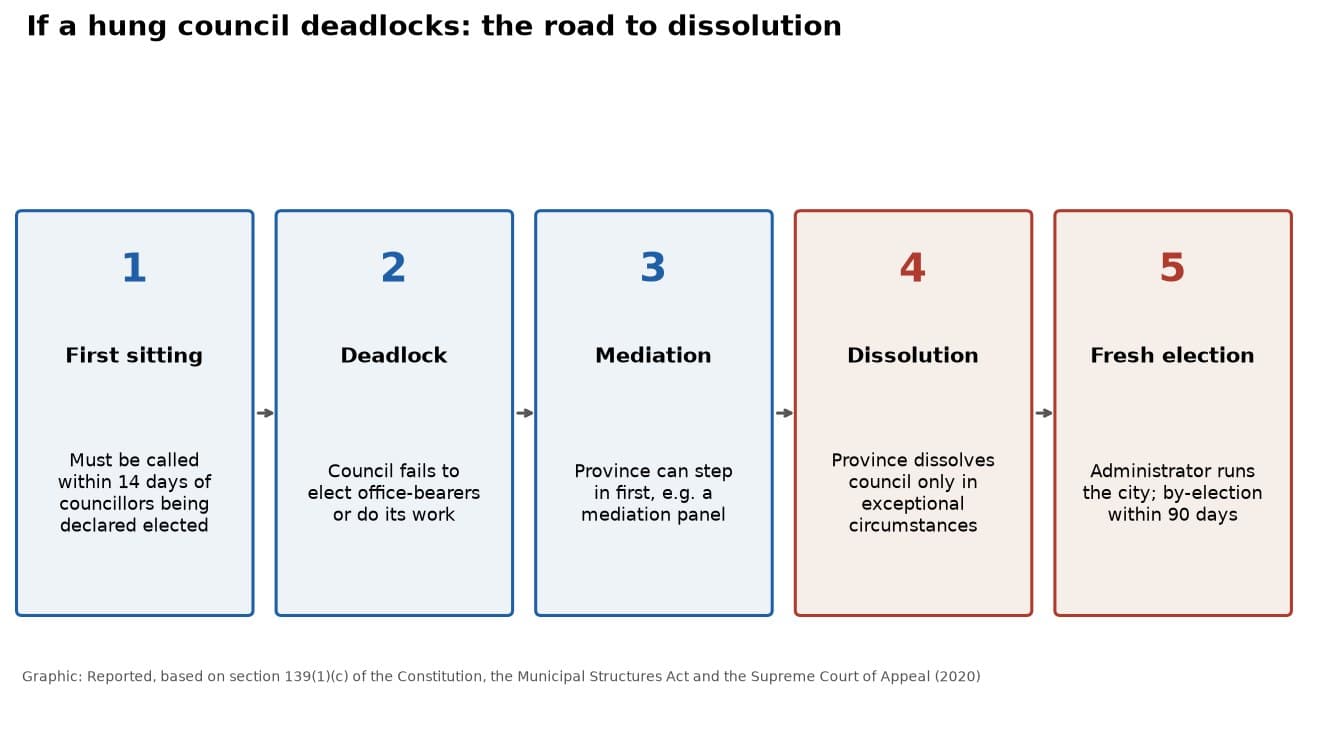
Yes, but only as a last resort. A provincial government can dissolve a municipal council and appoint an administrator, but the Constitution allows it only "if exceptional circumstances warrant such a step" (Constitution, section 139). A fresh election must then follow within 90 days (Supreme Court of Appeal).
The question is live because parties have less than two weeks to agree on coalitions in at least 137 hung councils (SABC News). Mpumalanga's CoGTA MEC Speed Mashilo has already warned that a council could be dissolved if its parties can't agree (Beloud).
What did the Mpumalanga MEC say?
Mashilo said the province would first try mediation where parties can't agree. "In the event that a conclusion can not be reached, even with mediation, then we will activate the law. We will then dissolve that municipality for re-election," he said, adding that he hoped it would not come to that (Beloud).
What is the deadline for electing a mayor?
The municipal manager must call the first council meeting within 14 days after the council has been declared elected, under section 29(2) of the Municipal Structures Act (Inside Politics). Coalition talks don't pause that deadline, so a council can sit without a deal in place (Inside Politics). At that first meeting, councillors must elect a speaker (Inside Politics), and then the mayor, by secret ballot.
When can a province dissolve a council?
Section 139 of the Constitution lets a province intervene when a municipality "cannot or does not fulfil an executive obligation". Dissolving the council and appointing an administrator is one of the options, and it needs exceptional circumstances (Constitution, section 139).
| Step | What the law says |
|---|---|
| Who decides | The provincial executive council |
| When | Only if exceptional circumstances warrant it |
| Who runs the city | An administrator, until a new council is declared elected |
| New election | Within 90 days of the dissolution |
Sources: Constitution, section 139(1)(c); Supreme Court of Appeal, 2020.
Has a council been dissolved like this before?
Yes. On 4 March 2020 the Gauteng executive council dissolved Tshwane's council and appointed an administrator. The DA challenged it, and the High Court in Pretoria reviewed and set aside the dissolution on 29 April 2020, ordering councillors to attend council meetings unless they had a lawful reason to be absent (Supreme Court of Appeal).
The Supreme Court of Appeal later dismissed the province's appeal against putting that order into effect. It held that an election must be held within 90 days of a council being dissolved, and that an administrator can't stay in office beyond that (Supreme Court of Appeal).
Would a fresh election fix a deadlock?
Not necessarily. Writing on Polity, analysts argued that dissolving dysfunctional metros and holding fresh elections is not a solution to local government's problems (Polity). A rerun can produce a similar split, and the administrator in charge in the meantime is not elected.
What happens to services in the meantime?
Your municipality keeps running through its administration while councils are formed. Reported explains who runs your municipality until the new council sits and how the secret ballot for mayor works.
FAQ
Can a municipal council be dissolved if it fails to elect a mayor?
A province can dissolve a council under section 139(1)(c) of the Constitution, but only if exceptional circumstances warrant it.
How soon must a new election be held after a council is dissolved?
Within 90 days of the dissolution, according to the Supreme Court of Appeal.
Who runs a dissolved municipality?
An administrator appointed by the province, until a newly elected council is declared elected.
Has a council been dissolved before?
Yes. Gauteng dissolved Tshwane's council in March 2020, but the High Court set the decision aside after a DA challenge.
Sources
- Constitution of South Africa, section 139 (Acts Online)
- Supreme Court of Appeal: Premier of Gauteng v DA (394/2020) [2020] ZASCA 136
- Beloud: Mpumalanga gives municipalities 14 days to constitute councils
- Inside Politics: How new municipal councils will be formed
- Polity: Dissolving dysfunctional metros not the solution
- SABC News: Political parties weigh coalition possibilities in Johannesburg