Coalitions Bill isn't law yet. What that means for new councils
Parliament can't rush the Municipal Coalitions Bill, Frolick says, so parties in hung councils still have 14 days, not the 30 the bill proposes, and only interim guidelines.
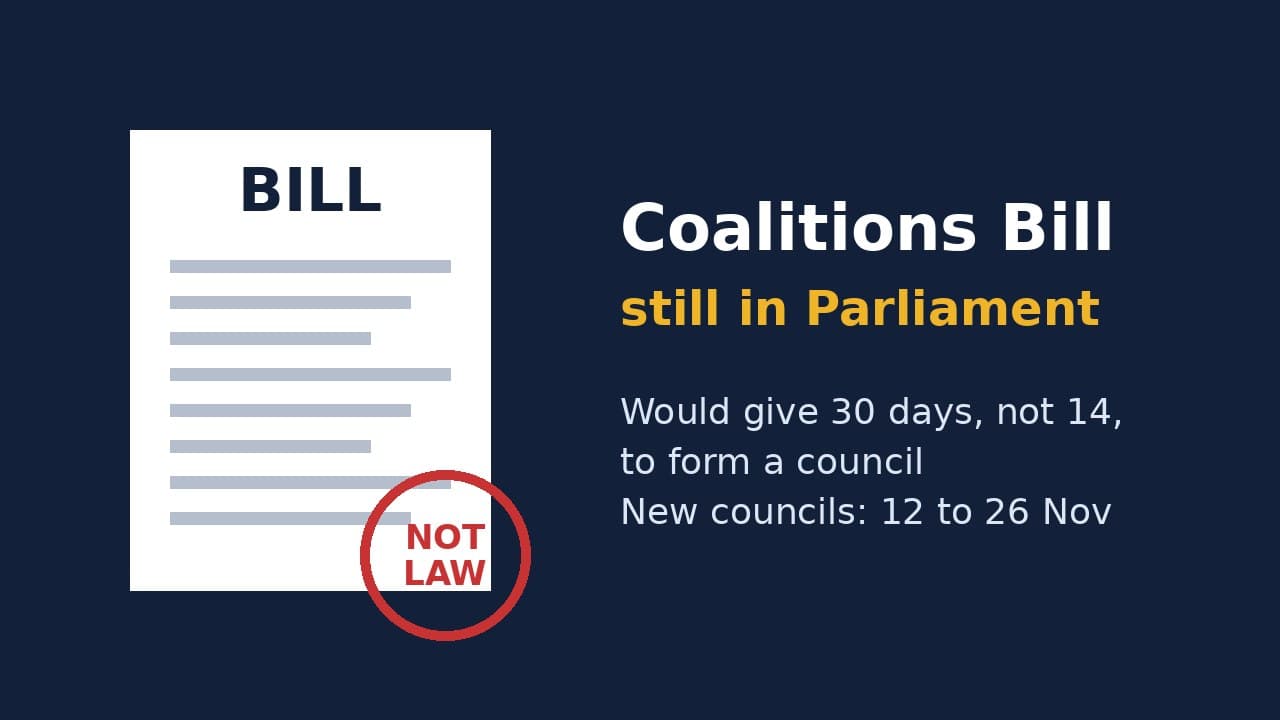
The Municipal Coalitions Bill, meant to make municipal coalitions more stable, is still not law and won't be ready for the councils now being formed, National Assembly House Chairperson Cedric Frolick said on 12 November (EWN). "Parliament cannot rush this bill... It's not viable. It cannot be done," he told MPs (EWN).
That means parties in hung councils are negotiating under the current rules, with 14 days to constitute councils, and only interim government guidelines to lean on (SAnews).
What is the Coalitions Bill?
Its formal name is the Local Government: Municipal Structures Amendment Bill of 2026 (SAnews). It aims to stabilise coalition governments in municipalities (EWN).
The bill was tabled in August, barely three months before the 4 November election (EWN). It goes through Parliament under the section 76 process, which involves both Houses (My Vote Counts).
What would it change?
The change most relevant right now: it would have given parties 30 days instead of 14 to negotiate coalition agreements, local government expert Professor Jaap de Visser said (EWN). "It's a pity that the bill hasn't been passed," he said, while warning there was "no silver bullet in this bill" (EWN).
Why can't Parliament pass it quickly?
Frolick said the bill must go through extensive public participation, and "any shortcuts that we take in terms of finalising that bill will come back to haunt us" (EWN).
Parliament's legal adviser warned in August that a bill feeling politically urgent does not allow Parliament to cut its timelines (EWN). Civil society group My Vote Counts points to Constitutional Court rulings, including Doctors for Life, that treat meaningful public participation as a binding requirement, so a rushed law could be challenged (My Vote Counts).
How did we get here?
| When | What happened |
|---|---|
| 2023 | The DA tabled the first of several private members' bills on coalition governments |
| After the 2024 election | Those bills were revived, then put on hold so government could draft a single bill |
| August 2026 | The government's bill was tabled in Parliament |
| 11 November 2026 | Cogta Minister Velenkosini Hlabisa issued interim coalition guidelines |
| 12 November 2026 | Frolick told MPs the bill cannot be rushed |
Source: EWN
MPs from the ACDP and EFF raised concerns on 12 November about the lack of legislation given the number of hung councils (EWN).
What rules apply to new councils now?
Hlabisa said the bill is still in Parliament and can't yet provide the intended framework, so his guidelines are an interim guide for negotiating coalition agreements and managing disagreements (SAnews).
Metro and local councils must be constituted in the statutory 14-day period, which runs from 12 to 26 November 2026. District councils follow once all their local councils are constituted (SAnews).
FAQ
Is the Municipal Coalitions Bill law?
No. It was tabled in August 2026 and is still going through Parliament. House Chairperson Cedric Frolick said it cannot be finalised before current coalition talks end.
How long do parties have to form new councils?
Metro and local councils must be constituted in the 14-day period from 12 to 26 November 2026. The bill would have allowed 30 days to negotiate coalition agreements.
What guides coalition talks in the meantime?
Interim coalition guidelines issued by Cogta Minister Velenkosini Hlabisa, which are meant to help parties negotiate agreements and manage disagreements until the law is passed.
Sources
- EWN: Frolick warns against rushing municipal coalitions bill
- EWN: It seems unlikely Coalitions Bill will be passed before local polls
- EWN Elections: It's a pity we don't have 30 days to get coalitions going
- SAnews: Hlabisa calls for proactive support to municipalities amid coalition talks
- My Vote Counts: Statement on the Coalitions Bill