Can your new mayor be voted out? How no-confidence votes work
Yes. A council can remove its mayor by resolution after prior notice, with no limit in the Act on how often. A bill in Parliament would allow it only once in 12 months, but it isn't law yet.
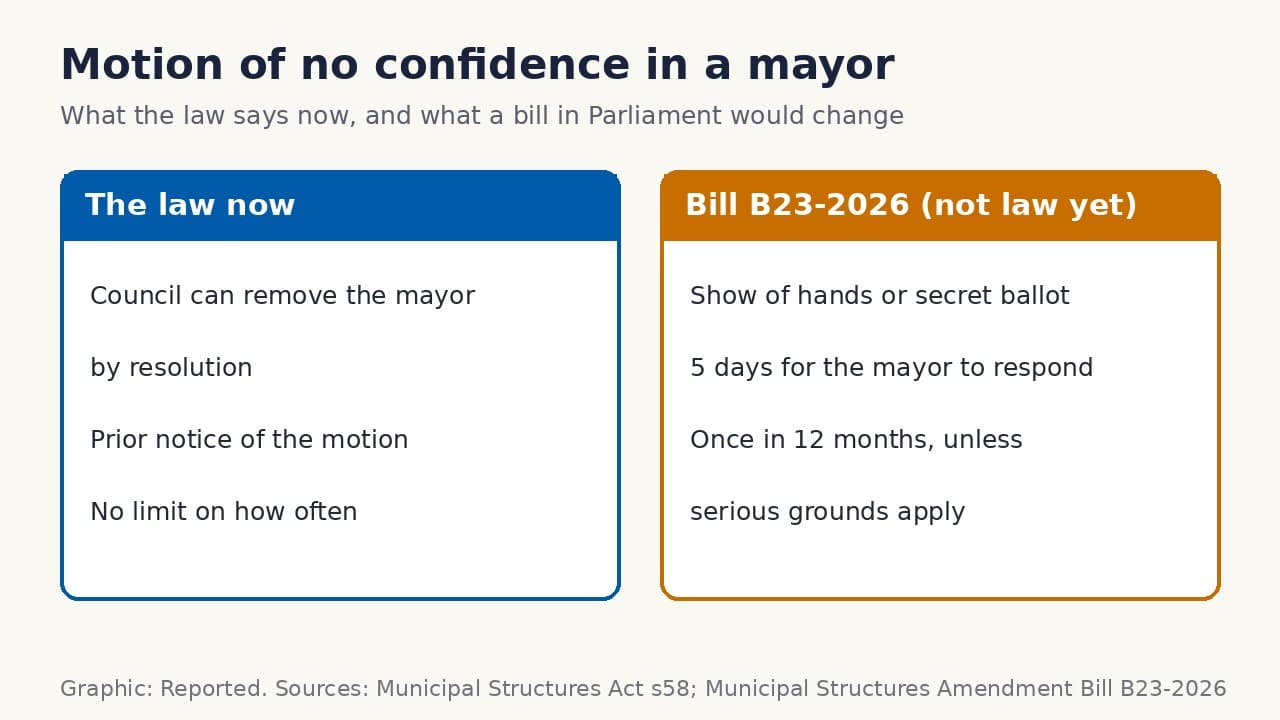
Yes. Under the law as it stands, a council can remove its executive mayor or deputy executive mayor by resolution, as long as prior notice of the motion is given. The Municipal Structures Act sets no limit on how often such a motion can be brought (Municipal Structures Act, section 58).
That matters now because 127 councils came out of the 4 November election with no party in charge (IOL), so many new mayors will depend on coalition partners staying on side.
How does a motion of no confidence work right now?
A councillor gives notice that they intend to move a motion to remove the mayor, and the council then votes on it. If the resolution passes, the mayor is removed (Municipal Structures Act, section 58).
The council then has to elect a new mayor. In a hung council, that means whoever can put together the most votes on the day.
Why do coalition mayors get removed so often?
Because a small partner switching sides can flip the numbers. CoGTA's new coalition guidelines warn that unstable coalitions can lead to repeated changes in leadership, with speakers and mayors removed and elected again, "sometimes opportunistically" (The National).
The guidelines say long periods of instability can slow or halt council decisions, hurt staff morale and open the door to fraud and corruption (The National).
It's also why some parties are weighing confidence and supply deals, where a party outside government agrees to vote against motions of no confidence in its partner's mayor (News24).
What would the Municipal Structures Amendment Bill change?
The bill, introduced by the Minister of Cooperative Governance and Traditional Affairs, would rewrite the rules for removing mayors, speakers and whips (Bill B23-2026):
| Rule | The law now | Under the bill |
|---|---|---|
| How the vote is taken | Resolution of the council | Show of hands or secret ballot, as the council decides |
| Notice | Prior notice | Prior written notice, with 5 days for the mayor to respond |
| How often | No limit in the Act | Once in 12 months |
| Exceptions to the 12-month limit | Not applicable | Violating the Constitution, certain criminal convictions, financial misconduct, a serious breach of the code of conduct, or being unable to do the job |
| First council meeting | Within 14 days | Within 30 days |
| Coalition agreements | Not in the Act | Written agreements between parties |
Sources: Municipal Structures Act and Municipal Structures Amendment Bill B23-2026.
Does the 12-month rule apply to the new councils?
Not yet. The bill is still going through Parliament, which is why CoGTA issued its guidelines as an interim framework (IOL). Local government expert Professor Jaap de Visser noted the changes were not passed before the election (EWN).
Until it becomes law, the current section 58 rules apply to every mayor elected in the coming weeks.
Are CoGTA's coalition guidelines binding?
No. The guidelines are non-binding and don't replace the Constitution or legislation. They include a model coalition agreement covering positions, policy priorities, decision-making and dispute resolution (The National).
FAQ
Can a mayor be removed by a motion of no confidence?
Yes. Under section 58 of the Municipal Structures Act, a council can remove its executive mayor or deputy executive mayor by resolution after prior notice of the motion is given.
Is there a limit on how often a motion of no confidence can be brought?
The current Act sets no limit. The Municipal Structures Amendment Bill would allow it only once in 12 months, except on listed serious grounds, but it is not law yet.
Will the 12-month rule protect mayors elected in November 2026?
Not unless the bill is passed. It was still going through Parliament when the new councils were being formed.
Are CoGTA's coalition guidelines law?
No. They are non-binding and do not replace the Constitution or legislation.
Sources
- Municipal Structures Act 117 of 1998 (SAFLII)
- Municipal Structures Amendment Bill B23-2026 (PMG)
- IOL: Hlabisa secures approval for new coalition guidelines
- The National: Hlabisa warns party spats must not stall service delivery
- News24: ANC divided on DA ahead of crucial coalition decision
- IOL: 127 hung councils, 14 days
- EWN: It's a pity we don't have 30 days, local government expert