Your new mayor must be elected by 22 November. Here's how it works
New councils must meet and elect a speaker and mayor within 14 days of being declared elected, which puts the deadline at 22 November 2026. Coalition talks can't delay it.
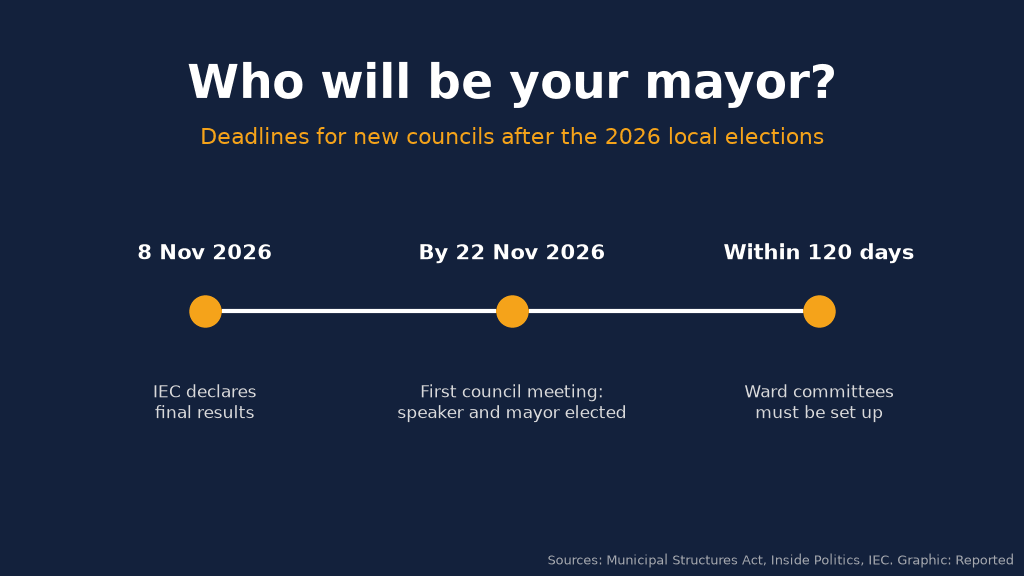
Every new municipal council has 14 days from the day it is declared elected to hold its first meeting, where councillors pick a speaker and a mayor. With the IEC declaring the results on Sunday, 8 November, that puts the deadline at Sunday, 22 November 2026 (Inside Politics; SAnews; Municipal Structures Act, section 29).
The clock runs from the date each council is formally declared elected, not automatically from the national announcement, so a council whose declaration came later could have a slightly later date (Inside Politics).
That leaves parties two weeks to strike coalition deals in the hung councils, including seven of the eight metros. Cape Town is the only metro where one party, the DA, won an outright majority of seats (BusinessTech; Africanews).
You don't vote for your mayor directly. Who does?
Your councillors do. Voters elect ward and proportional representation councillors, and the council then elects the mayor at its first sitting (Inside Politics).
| Step | What happens | Deadline |
|---|---|---|
| First council meeting | Municipal manager convenes it. If there is no municipal manager, the provincial MEC for local government appoints someone | Within 14 days of the council being declared elected |
| Speaker | Elected first; runs council meetings | At the first meeting |
| Mayor | Executive mayor elected by council, or mayor chosen from the executive committee in councils using that system | Within 14 days of the council's election |
| Councillors for district councils | Local councils send representatives | Within 14 days |
| Ward committees | Set up in every metro and local council | Within 120 days |
Sources: Inside Politics, Municipal Structures Act
District councils run on a separate clock. Their 14 days start only once all the representatives sent by local councils are in place (Inside Politics).
Can coalition talks push the deadline back?
No. Negotiations don't pause the legal deadline, so parties could walk into the first meeting with no signed deal and still have to vote. A coalition agreement on its own doesn't elect anyone; the vote in council does (Inside Politics).
The voting for speaker and mayor is by secret ballot. The Municipal Structures Amendment Bill, which would have given parties 30 days instead of 14, made coalition agreements public and made the mayoral vote open, was not passed before the election, local government expert Professor Jaap de Visser told CapeTalk (EWN).
What if councillors are tied?
The Act sets out tie-breaking rules, which can include further rounds of voting and, where prescribed, drawing lots (Inside Politics). De Visser warned that some councils could end up with an office-bearer "elected by the throw of a dice" (EWN).
Who runs your water and electricity in the meantime?
The municipal administration. The municipal manager, chief financial officer and senior officials keep running services such as water, electricity and refuse collection while the political leadership changes (Inside Politics).
Outgoing councils must hand over a political report and an administrative report, covering finances, service backlogs, audit results and debts, before the new council's first meeting. Government guidelines also tell municipalities to prioritise paying creditors such as Eskom and water boards to avoid service cuts. Officials may not take part in coalition talks or use municipal cars, venues or money for them (Inside Politics).
Where do talks stand in the big councils?
These are the parties' own public positions as of Monday, 9 November. Nothing has been signed.
| Council or party | Latest public position |
|---|---|
| Johannesburg | DA largest party with 35% of the vote, short of a majority. Informal talks started on Friday (BusinessTech) |
| Tshwane | ActionSA leader Herman Mashaba says any deal involving ActionSA must keep Nasiphi Moya as mayor (EWN) |
| MK Party | Negotiator Dali Mpofu says MK will enter talks without preconditions (EWN) |
| ANC | Secretary-general Fikile Mbalula said deals should not be driven by "transactions of mayoral positions" (EWN) |
| Buffalo City | ANC provincial leaders say they could govern as a minority if talks fail; the UDM has ruled out working with the ANC (The Herald) |
President Cyril Ramaphosa urged parties on Sunday not to let disagreements hold essential services hostage (Africanews).
We'll update this page as mayors are elected in the metros.
FAQ
When will new mayors be elected after the 2026 local elections?
Councils must hold their first meeting within 14 days of being declared elected. With results declared on 8 November 2026, the deadline is 22 November 2026, and the speaker and mayor are elected at that meeting.
Do voters elect the mayor directly in South Africa?
No. Voters elect councillors, and the council elects the mayor at its first meeting by secret ballot.
Can coalition talks delay the first council meeting?
No. The 14-day deadline in the Municipal Structures Act still applies even if parties have not signed a coalition agreement.
What happens if councillors are tied in a mayoral vote?
The Municipal Structures Act sets out tie-breaking steps, which can include further voting rounds and, where prescribed, drawing lots.
Who runs municipal services before the new mayor is elected?
The municipal administration, led by the municipal manager and chief financial officer, keeps services such as water, electricity and refuse collection running.
Sources
- Inside Politics: how new councils will be formed
- Municipal Structures Act (SAFLII)
- SAnews: IEC declares LGE 2026 free and fair
- EWN: coalition talks after LGE 2026
- EWN: Jaap de Visser on 30 days
- EWN: Mashaba on Tshwane mayor
- EWN: Mpofu on MK coalition talks
- BusinessTech: fight for Gauteng
- The Herald: Eastern Cape coalition haggling
- Africanews: Ramaphosa reacts