Is your light bulb now banned? The 105 lumens-per-watt rule explained
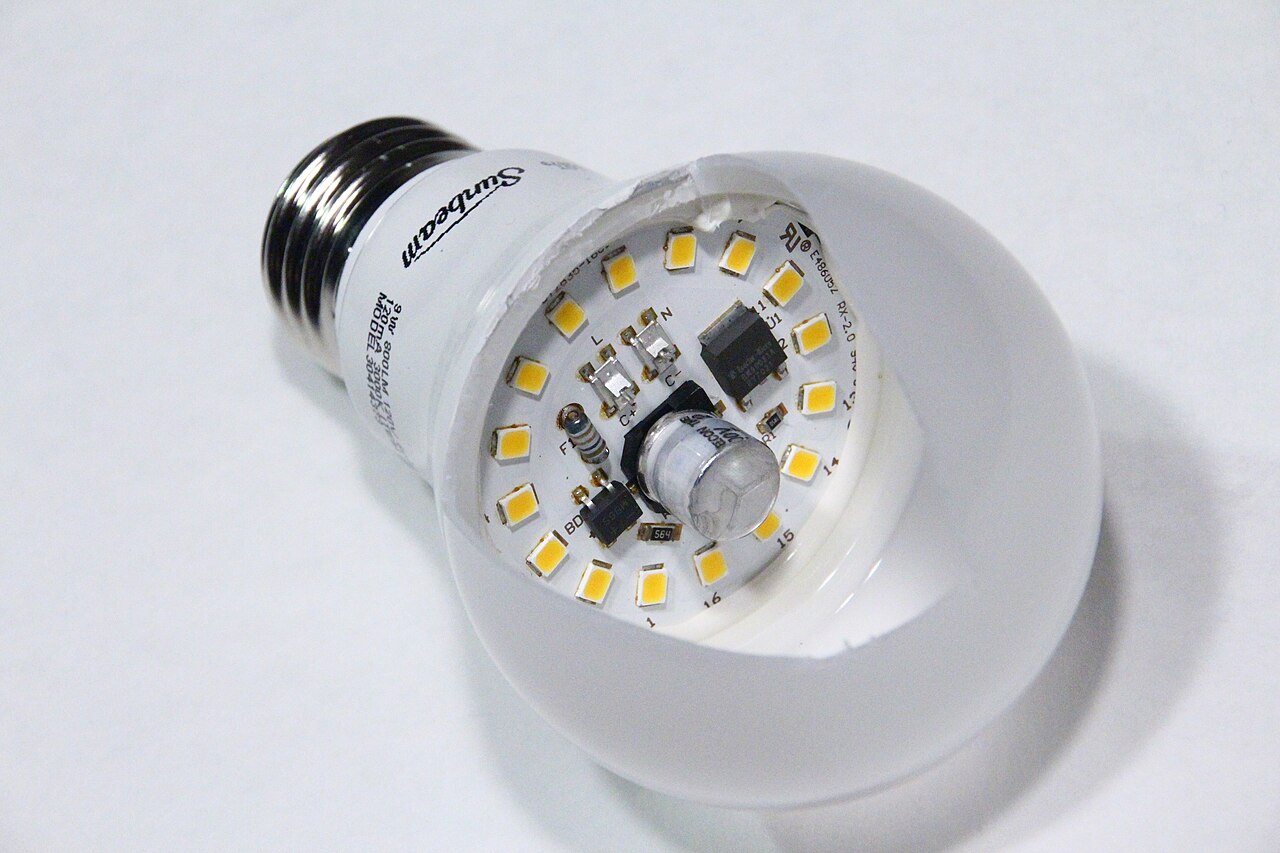
Loadmaster / Wikimedia Commons, CC BY-SA 4.0
New light bulbs sold for general home use in South Africa must now produce at least 105 lumens of light per watt of electricity. That bar, set by the National Regulator for Compulsory Specifications (NRCS), took effect on 24 May 2026 and rules out ordinary incandescent and most compact fluorescent (CFL) bulbs (NRCS communique, Government Gazette 48652).
The rule is back in the news after MyBroadband reported on 23 October that third-party sellers on Makro's online marketplace had listed CFLs rated at 24 to 73 lumens per watt. Massmart, which owns Makro, told the publication it removed the listings it was shown and is reviewing the whole category (MyBroadband).
What does the light bulb rule actually say?
The rule is compulsory specification VC 9109, published by the trade, industry and competition minister in the Government Gazette on 24 May 2023 (Gazette). It replaced the old specifications for incandescent lamps and single-capped fluorescent lamps.
It came in two steps (NRCS communique):
- 24 May 2024: minimum of 90 lumens per watt
- 24 May 2026: minimum of 105 lumens per watt
Which bulbs are covered?
Most bulbs you'd buy for a ceiling light, lamp or downlighter. The rule covers incandescent, halogen, fluorescent and LED lamps giving off 60 to 3,300 lumens of white light, running on up to 300V, with common household fittings (Gazette):
- Screw: E14, E27 and similar
- Bayonet: B22 and similar
- Pin: GU10, G9, GU5.3 and others
Which bulbs are exempt?
The gazette lists exclusions for lamps not meant for general lighting, as long as the packaging clearly says so (Gazette). These include:
- Grow lights, aquarium, animal care and anti-insect lamps
- Oven-type lamps that must handle over 120°C (small incandescent or halogen bulbs, max 25W)
- Emergency lighting, traffic and signalling lamps
- Studio and theatre lighting
- Bulbs in battery-powered products such as torches, camping lights and solar garden lights
How do I check if a bulb meets the rule?
Divide the lumens on the box by the watts. An 800-lumen bulb (sold as a "60W equivalent") needs to draw no more than about 7.6W to reach 105 lumens per watt.
Some bulbs get a lower bar. The minimum drops by 10% for bulbs under 400 lumens and colour-changing bulbs, and by 15% for directional lamps such as spotlights, up to a combined maximum of 25% (Gazette). Smart LED bulbs also get a smaller allowance depending on brightness.
If a box claims a wattage equivalent, the gazette sets the minimum light output for it: 800 lumens for "60W" and 1,500 lumens for "100W", for example (Gazette).
Can shops still sell older bulbs?
Only in limited cases. Approvals (letters of authority) issued under the 90 lumens per watt step stay valid until they expire but can't be renewed. Once one expires, the holder can apply to the NRCS for a sales permit to clear leftover stock, backed by records (NRCS communique).
The specification sets what may be approved for sale. It says nothing about bulbs already fitted in your home.
FAQ
Are incandescent light bulbs banned in South Africa?
New general-use bulbs must reach 105 lumens per watt since 24 May 2026 under NRCS specification VC 9109. Standard incandescent bulbs fall well short, so they can't be approved for general sale. Specialised lamps, such as oven bulbs, are exempt.
When did the 105 lumens per watt rule start?
24 May 2026. The first step, 90 lumens per watt, started on 24 May 2024.
How do I work out a bulb's lumens per watt?
Divide the lumens on the packaging by the wattage. For example, an 800-lumen bulb must use about 7.6W or less to meet 105 lumens per watt.
Do I have to replace the bulbs already in my house?
The specification governs which bulbs may be approved for sale. It does not mention bulbs already installed in homes.
Can shops still sell old stock?
Only with NRCS approval. Phase 1 letters of authority stay valid until expiry, then the holder can apply for a sales permit to clear remaining stock.